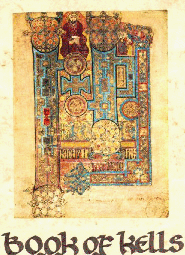
“Book of Kells”
by Jerry B. Lincecum
[Note: This article appeared in the Fort Worth Star-Telegram
on March 29, 1990]
Ireland's famed “Book of Kells,” the Western world's most beautiful
illuminated manuscript, is also one of our greatest riddles.
Now, thanks to a superb fine art facsimile edition, scholars
and students at Texas Christian University and Austin College
can study it from cover to cover in search of new answers. Trinity College in Dublin also provides a website.
One copy of the expensive facsimile edition, valued at $18,000
per book and limited to 1,480 copies worldwide, was presented
to Austin College in Sherman last night. Another goes to the
Texas Christian University library in special ceremonies tonight.
Since the Austin College copy arrived early (two days before
St. Patrick's Day!), I have had the privilege of poring over
this gorgeous and sacred book. As for the riddles of its origin,
I began puzzling over those even before my first visit to Trinity
College in Dublin to view the original in 1970.
As best we can determine, the Book of Kells was copied by
hand and illuminated by monks around the year 800 A.D. Although
it was probably begun on the island of Iona, between Scotland
and Ireland, its name is derived from the Abbey of Kells, in
the Irish Midlands, where it was kept from at least the 9th century
to 1541. One theory has it that portions of the book were made
at Kells, after Viking raids on Iona forced the monastery to
retreat to the more isolated location, is uncertain.
The book consists of a Latin text of the four Gospels, calligraphed
in ornate script and lavishly illustrated in as many as ten colors.
Only two of its 680 pages are without color. Not intended for
daily use or study, it was a sacred work of art to appear on
the altar for very special occasions.
Since 1661 the Book of Kells has been kept in the Library
of Trinity College in Dublin. The fact that the preservation
of medieval manuscripts requires strict conservation measures
was not understood in the 19th century and the book suffered
from more than the ravages of time. It suffered damage when it
was improperly rebound in ?. Not recognizing that some of the
pages varied in size, the binder actually cut off some of the
gorgeous illumination in order to standardize the size.
In 1953 the book had to undergo a major process of restoration.
At that time it was rebound into four volumes, permitting greater
access. In Dublin two volumes of the Book are displayed daily
under strictly controlled conditions, while the other two are
available to a few privileged scholars. Pages are turned on a
regular schedule to allow the public to view different sections
of the book. Thousands flock to Trinity College annually to view
this sacred book that is also the finest surviving example of
the art of illumination and Celtic art.
To make this treasure more accessible, officials at Trinity
College decided in 1986 to allow a limited number of high quality
facsimiles to be made by a Swiss publisher, Urs Duggelin, whose
firm (Faksimile Verlag or Fine Art Facsimile Publishers) specializes
in reproduction of rare illuminated manuscripts and has an outstanding
reputation. Duggelin considers this project the fulfillment of
a lifetime dream, but when he first proposed it, officials at
Trinity College said no, unequivocally.
But when he offered to observe unusually strict security and
preservation measures, the door opened. The original was not
to be removed from Dublin. It could not be unbound (usual practice
for photo reproduction), and worst of all, its pages were not
to be touched by anyone or anything--not even a glass photographic
plate.
Undeterred, Duggelin invested a quarter of a million Swiss
francs and two and a half years of work to invent a unique machine
that allowed them to photograph the book without touching it.
The photography was done over several days in August 1986.
Then the real work began. Master lithographers and craftsmen
drew upon computer enhancement as well as their own skill to
reproduce a true facsimile (the latin word means "Make it
the same!"). Each page traveled an average of five times
between Ireland and Switzerland.
The copy recreates faithfully the present-day condition of
the original, including some 580 holes made by beetles, weevils,
and the aging process. Normal color printing is limited to four
colors, but some pages of the Book of Kells had ten colors, so
a more complicated and costly process was followed. The books
are bound and sewn by hand, following a medieval process that
requires great skill.
What do we know about the artists and craftsmen who made the
original, almost 1200 years ago? Not very much. No records have
come down to us. There is no list of credits, not even an account
book. There are some visual clues, however. Experts who have
studied the manuscript have been able to identify only four "hands"
in the calligraphy. But medieval artists were known to use themselves
as models on occasion, and one scholar has posited the theory
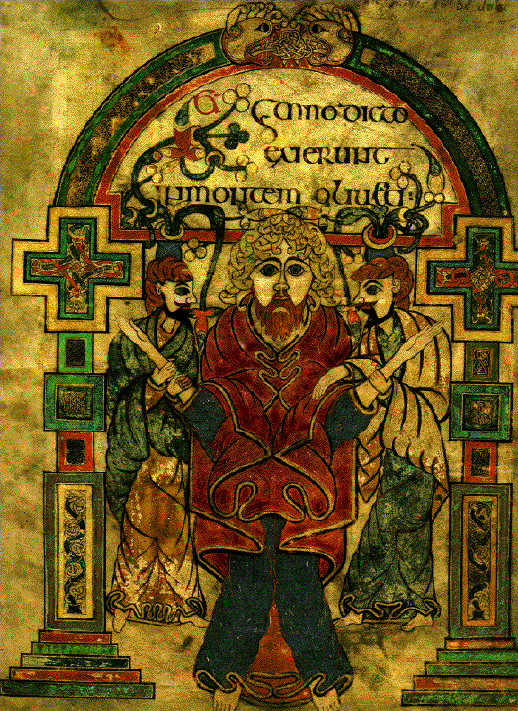
that the nine apostles who are depicted on page 202 just might
be the book's creators.
Four were master-painters and calligraphers. The other five
would have kept busy preparing the pages, mixing colors, making
tea, and (when their masters backs were turned) taking us the
brush and having fund. No doubt some of the amusing little animals
and birds that the book is famous for were done by apprentices.
The masters must have been short-sighted, because only when
a 10-factor magnifying glass is applied to the figure of St.
Luke on page 201 does one see the breathtakingly intricate and
exact decoration. There are numerous other examples of this kind
of fine detail, and magnifying glasses of that power were not
invented until hundreds of years later.
Two of the painters stand out by virtue of their genius and
their contrasting style. One was Celtic (either Irish or Scottish).
He was exact, orderly and neat, always using black ink made of
iron-gall. His exquisite writing alone would make the book a
masterpiece. His colors are blue and green. Toward the end of
the book are two of his pages, with blue letters on one and the
complementary green on the other.
His greatest rival must have been a southerner--an Arab, an
Armenian, or an Italian. He knew the art of the Mediterranean
world and painted in a style that is bold, even fantastic, and
a perfect foil the swirling gracefulness of Celtic art. He will
start a section of text in black, throw in a chunk of scandalous
scarlet, shift into brown, then return to black. He is forever
throwing in wilful little details--sprigs of wild flowers, eccentric
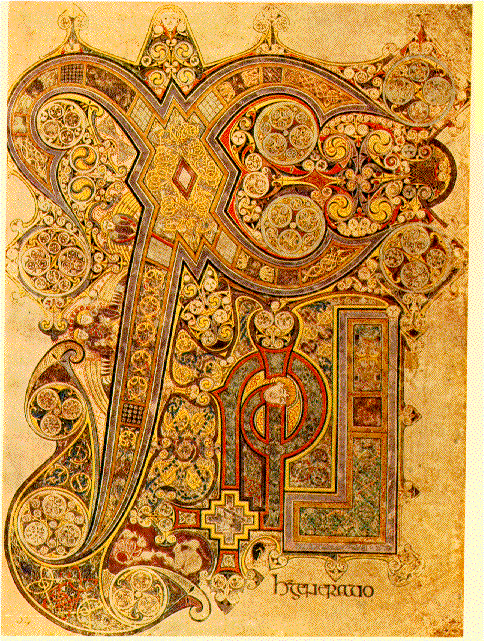
dots and diamonds. His is certainly the greatest page of the
Book of Kells, the fabulous "Chi Rho" page (so called
after the Greek initial letters of Christ's name).
There are enough puzzles and conundrums in this masterpiece,
not to mention splendid images and awe-inspiring calligraphy,
to intrigue students and scholars at Austin College and Texas
Christian University for years to come.
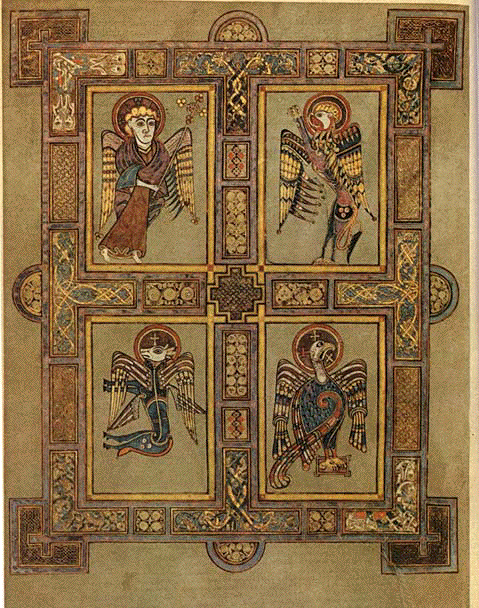
These images are from the Book of Kells Images.


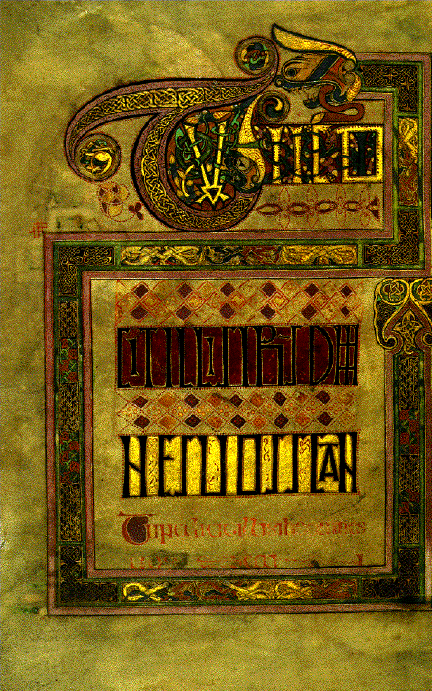
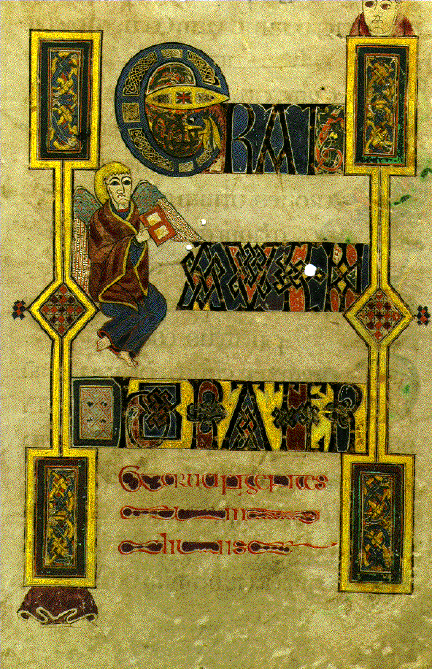
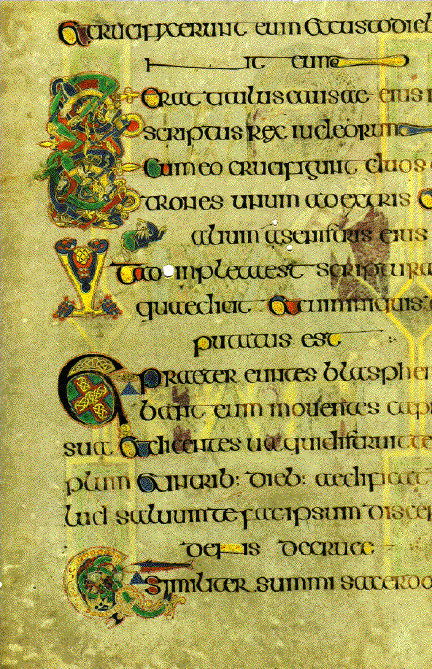
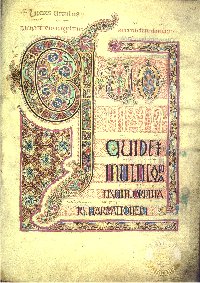 Similar art can be found in the Lindisfarne
Gospels. Similar art can be found in the Lindisfarne
Gospels.
The Lindisfarne Gospels are one of the treasures
of the Christian Church in Northumbria. They were produced in
the 7th century at a time which is sometimes called the "Golden
Age of Northumbria" when learning and artistic skills were
at a peak. This was the age in which the Venerable Bede wrote
his "Ecclesiastical History" and in which the great
Celtic Saints like Aidan and Cuthbert carried out their missionary
work for the conversion of the North.
The Lindisfarne Gospels are currently in the care of the British
Library, in London, but the Diocese of Durham hosts some high
quality images from sample pages of the gospels. Click on the
thumbnail images to fetch the full size version.
Back to Beowulf
or Assignments or Home.
|